
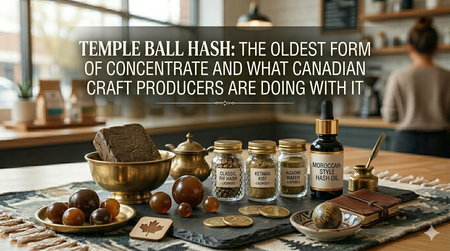
TL;DRTemple balls are hand-rolled hash made from fresh resin collected by rubbing live cannabis plants — one of the oldest concentrate forms in the world, and one of the smallest categories on Canadian licensed shelves. What exists is mostly craft-tier, limited-run, and worth finding.Temple balls are charas — hand-rubbed, not sieved or pressed — which is what separates them from every other hash styleCanadian licensed temple ball SKUs are rare; expect limited availability and higher price points
The exterior cures differently from the interior — that's normal, not a quality defect
Most concentrate categories in Canada have a market story: who leads on availability, what the price spread looks like, which LPs scaled production first. Temple ball hash has a different story. It's the category where the licensed market is still catching up to a tradition that predates every other extraction method by centuries — and where the best Canadian product comes from producers who approached it as craft rather than volume.
This post covers what temple balls actually are, why they're rare on Canadian shelves, and what to look for when you find one. For the production pipeline and history, the hash guide covers the full picture. This is the buyer's view.
What makes a temple ball different from every other hash
The method. Temple balls — charas in the Himalayan tradition they come from — are made by rubbing live, unharvested cannabis plants between the palms until resin collects on the skin, then rolling that resin into balls. No screens. No ice water. No pressing equipment. Just hands and fresh plant material.
That's not a romantic detail — it's a functional one. The hand-rub process collects intact trichome heads along with a small amount of plant wax, which gives temple balls their characteristic dark, almost lacquer-like exterior and the notably different texture from dry-sieve or bubble hash. The interior stays lighter and more pliable; the exterior cures into a firm shell over time.
The aroma profile follows from the method: fresh, almost green, with the specific terpene character of the strain preserved because the plant was still alive when collection happened. This is what separates charas from every other traditional hash style — it's always made from live plant material, which puts it closer to the "live" concentrates in terms of terpene preservation.
Why temple balls are rare in Canadian licensed retail
Two reasons, both real.
First: yield is extraordinarily low. Hand-rubbing is slow, labour-intensive work that produces a fraction of what dry-sieve or ice-water extraction yields from the same amount of plant material. For a licensed producer operating at scale, the economics are difficult — the labour cost per gram is high and the output is limited.
Second: the regulatory environment adds complexity. Licensed producers in Canada work with harvested, dried cannabis by default. Producing authentic charas requires working with live plants — which is possible under a cultivation licence but requires specific process controls that most producers haven't set up for a low-volume category.
The result: temple ball SKUs in Canadian licensed retail are rare, often limited-run, and concentrated among craft-tier producers who built their process around the method rather than retrofitting it. When you see a temple ball on a Canadian shelf, it's almost always because someone at that LP specifically chose to make it, not because the production line produces it at scale.
What's on Canadian shelves right now
The temple ball category is thin enough that naming specific SKUs without current availability data would mislead more than it helps. What I can say: producers in the craft hash space — the same names that show up consistently for quality bubble hash and dry-sieve — are the ones most likely to have temple ball SKUs in rotation.
Check the hash hub filtered to your province before making a trip. Temple ball availability is genuinely patchy — it may be in five stores in your city or none. This is one of the categories where the BBFYB availability filter earns its keep.
How to evaluate a Canadian temple ball before buying
The exterior of a temple ball is supposed to look different from the interior. A dark, almost shiny outer layer with a lighter, more pliable inside when broken is correct — that's the resin oxidising and curing on the surface. It's not degradation and it's not plant contamination. If someone tells you a dark exterior means old or low-quality product, they're thinking of pressed hash conventions, not charas.
What to actually look for:
- Aroma. Should be loud, fresh, and strain-specific. Temple balls made from live plant material carry a terpene character that pressed hash doesn't — brighter, more volatile, closer to fresh flower than to dried and cured product. If it smells flat or generic, the starting material was likely not live
- Texture on break. The interior should be noticeably more pliable than the exterior, with a slightly tacky quality. Uniformly hard all the way through suggests the product may have dried out or may not be authentic charas
- Combustion. Temple balls burn slowly and evenly when crumbled on a bowl. They don't crumble easily — you'll need to warm a piece between your fingers first. That's normal and correct
How to consume temple ball hash
The traditional method is crumbled into a chillum — a straight conical pipe — with or without tobacco. In the Canadian context, the practical methods are:
- Crumbled on a flower bowl. Warm a small piece between your fingers until it softens, then break it into small pieces over packed flower. The most common method and the most forgiving
- Rolled into a joint. Same warming step, then roll a thin snake of hash along the length of your joint before closing. Burns slower than flower alone
- Hot knife or banger. Temple balls can be dabbed at low temperature but it's not the ideal method — the plant wax content means it won't fully melt the way full-melt bubble hash does. Expect some residue
The Malana connection
The temple ball originates primarily from Nepal, where charas has been documented as far back as 1694 and where the hand-rub tradition is most deeply embedded in culture and ritual. The broader charas tradition spans Nepal, northern India, and Pakistan — the hand-rub method was the practical response to humid mountain climates where drying and sieving were difficult.
The most famous Indian expression of this tradition comes from Malana, a village in the Kullu district of Himachal Pradesh — the source of Malana Cream, which built its reputation on the specific resin character of the cannabis varieties grown there and won the High Times Cannabis Cup in 1994 and 1996. The Manali and Kasol regions of Himachal Pradesh have their own traditions as well.
None of this is legally importable into Canada. What Canadian craft producers are doing is applying the charas method to domestic cannabis varieties — and while the genetic base is different from the Himalayan landraces, the method produces a genuinely distinct product that no other extraction process replicates.
Temple balls vs other pressed hash — the key differences
FAQ
What is a temple ball? Hand-rolled hash made by rubbing live cannabis plants between the palms to collect resin, then rolling the collected resin into a ball. Also called charas. One of the oldest concentrate forms in the world, originating in the Himalayan tradition of Nepal and northern India.
Why are temple balls so rare in Canada? Low yield and labour-intensive production make the economics difficult for licensed producers operating at scale. Authentic charas requires working with live plants, which adds process complexity under Canadian cannabis regulations.
Is the dark exterior on a temple ball a sign of low quality? No. The dark, lacquer-like outer layer is the resin oxidising and curing on the surface — it's correct for the product type. The interior should be lighter and more pliable when broken.
How do you smoke temple ball hash? Crumble a warmed piece over a packed flower bowl or roll it into a joint. The traditional method is a chillum pipe. Temple balls can be dabbed at low temperature but expect some residue — they won't fully melt like full-melt bubble hash.
What's the difference between temple ball hash and other pressed hash? Method and starting material. Temple balls are made by rubbing live plants by hand — no screens, no water, no pressing equipment. Moroccan and Afghan-style hash use dried plant material and mechanical sieving or pressing. The live starting material gives temple balls a fresher, more volatile terpene profile.
Where can I find temple ball hash in Canada? Availability is limited and varies by province. Check the hash hub for current SKUs near you before making a trip.
Subscribe to our email newsletter and unlock access to members-only content and exclusive updates.
Comments