
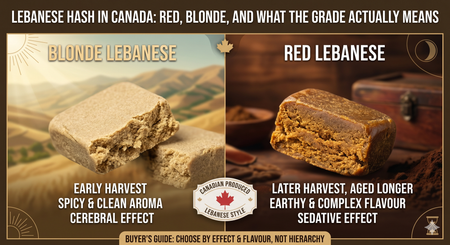
TL;DRLebanese hash comes in two grades — blonde and red — determined primarily by harvest timing and curing, not quality ranking. Both are dry-sieve pressed traditions from the Bekaa Valley, and both are legally produced in Canada by licensed producers using domestic cannabis.Blonde Lebanese is harvested earlier, lighter in colour, spicier and cleaner in aromaRed Lebanese is harvested later and aged longer, darker, earthier, with a more complex flavour profile
Neither grade is objectively better — they're different expressions of the same tradition
Lebanese hash is one of the more misunderstood categories on Canadian shelves, mostly because the grade names — blonde and red — get interpreted as a quality hierarchy when they're actually a harvest timing and curing distinction. Blonde isn't premium. Red isn't inferior. They're different products that happen to come from the same tradition and the same region.
This post covers what actually separates the two grades, what Canadian licensed producers are making in the Lebanese style, and how to choose between them. For the full production breakdown, the hash guide has it covered. This is the buyer's view.
The Bekaa Valley — brief context
Lebanese hash originates in the Bekaa Valley in eastern Lebanon, one of the oldest continuous cannabis cultivation regions in the world. The valley's climate — high altitude, dry summers, significant temperature swings between day and night — produces cannabis with a resin profile that's distinct from Moroccan or Afghan landraces.
The traditional production method is dry sieve: cannabis is harvested, dried, and then sieved through fine screens to collect trichomes, which are then pressed into slabs or bricks. The same method as Moroccan hash, different plant and different climate.
None of this is importable into Canada. What licensed Canadian producers are doing is applying the Lebanese dry-sieve tradition to domestic cannabis — same process, different terroir.
What actually separates blonde from red
Harvest timing and curing — that's the core distinction.
Blonde Lebanese is made from cannabis harvested earlier in the season, before full maturity. The resin at that stage is lighter in colour, higher in certain terpenes, and produces hash with a pale gold to light tan appearance, a spicy and almost citrus-forward aroma, and a cleaner, more cerebral effect profile.
Red Lebanese is made from cannabis harvested at or past full maturity, then cured and aged for extended periods — sometimes a full season or longer. During this time, UV exposure and oxidation darken the resin, THC gradually converts to CBN, and the terpene profile shifts toward earthier, more complex compounds. The resulting hash is darker — amber to reddish-brown — with a heavier, more sedative character and a flavour that reads as earthy and slightly sweet rather than spicy and bright.
Neither is the premium product. A well-made red Lebanese from a producer who knows what they're doing is a better product than a poorly made blonde. The grade tells you the style; it doesn't tell you the quality.
What's on Canadian shelves
Lebanese-style hash exists in the Canadian licensed market but sits in a narrower availability band than Afghan-style product. The category is identifiable by labelling: "Lebanese," "Leb," "blonde hash," or "red Lebanese" on the label are the signals to look for. "Blonde hash" as a standalone label sometimes refers to Lebanese style and sometimes refers to colour-grading within another tradition — the Blonde hash post covers that distinction in more detail.
Producers making Lebanese-style hash in Canada include names from the craft pressed hash space — the same LPs showing up consistently in the dry-sieve and Moroccan-style categories. Check the hash hub for current Canadian availability near you, filtered by province.
How to choose between blonde and red
Effect profile first, then aroma preference.
If you're looking for a daytime hash — something with a cleaner, more functional high and a spicy, bright nose — blonde Lebanese is the call. The earlier harvest timing and lighter terpene profile tend to produce a more energetic effect than red.
If you're looking for an evening or end-of-day product — something heavier, more sedative, with a complex earthy flavour that develops over a slow burn — red Lebanese is what you want. The later harvest, extended curing, and higher CBN content produce a different experience at the effect level, not just the flavour level.
The practical answer for buyers who haven't tried either: start with blonde. The flavour profile is more distinctive relative to other hash styles on Canadian shelves, and it's a cleaner introduction to the Lebanese tradition. Red Lebanese is excellent but easier to appreciate once you have the blonde as a reference point.
Reading the label on Lebanese hash
A few things worth confirming before you buy:
- "Dry sieve" or "dry sift" on the label. This is the correct production method for Lebanese-style hash. Ice-water extraction or "bubble" on the label means it's a different product regardless of what the marketing says
- Colour in the jar. Blonde should be pale gold to tan. Red should be amber to reddish-brown. Significantly darker than expected for either grade — almost black — may indicate older product or a different process
- Aroma on opening. Blonde should be spicy, slightly floral, with a brightness that distinguishes it clearly from Afghan-style hash. Red should be earthier and more complex. If either smells generically "weedy" with no distinguishing character, the terpene profile hasn't been preserved well
Lebanese vs Moroccan vs Afghan — the quick comparison
All three are dry-sieve pressed traditions. The differences:
- Lebanese: Bekaa Valley origin, harvest-timing grades (blonde/red), spicy and bright (blonde) or earthy and complex (red), cleaner burn than Afghan
- Moroccan: Rif Mountain origin, single-grade dry-sieve tradition, incense and floral aromatics, pliable texture
- Afghan: Central Asian origin, dry sieve (Garda) + press, indica-dominant genetics, musky and earthy, the most widely available pressed hash category in Canada
The Lebanese tradition produces the widest flavour range of the three because the two harvest grades express genuinely different terpene profiles — not just variations on the same theme.
FAQ
What's the difference between blonde and red Lebanese hash? Harvest timing and curing. Blonde is harvested earlier — lighter colour, spicier and brighter aroma, cleaner effect profile. Red is harvested later and aged longer — darker, earthier, more complex flavour, heavier effect with higher CBN. Neither is the premium grade; they're different expressions of the same tradition.
Is blonde Lebanese hash better than red? No. The grade names refer to harvest timing and curing, not quality ranking. A well-made red Lebanese is a better product than a poorly made blonde. Choose based on effect and flavour preference, not grade hierarchy.
Can you buy Lebanese hash in Canada? Not authentic Bekaa Valley product — importing hashish from Lebanon is illegal under the Cannabis Act. Licensed Canadian producers make Lebanese-style hash using the traditional dry-sieve method with domestic cannabis.
What should Lebanese hash smell like? Blonde Lebanese: spicy, slightly citrus or floral, bright. Red Lebanese: earthy, complex, slightly sweet. Both should be clearly aromatic and strain-specific. Flat or generic aroma suggests poor terpene preservation.
How do I know if a Canadian product is genuinely Lebanese style? Look for "dry sieve" or "dry sift" on the label — that's the correct production method. Colour should match the grade: pale gold for blonde, amber to reddish-brown for red. Aroma should be distinctly spicy (blonde) or earthy and complex (red).
How do you smoke Lebanese hash? Same methods as other pressed hash — crumbled on a flower bowl, rolled into a joint, or on a hot knife. Lebanese hash burns cleanly and evenly. Not ideal for dabbing; the dry-sieve process leaves enough plant material that it won't fully melt on a banger.
Subscribe to our email newsletter and unlock access to members-only content and exclusive updates.
Comments