
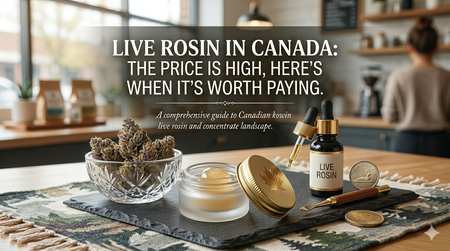
TL;DRLive rosin is fresh-frozen cannabis pressed into solventless oil, and it's the most expensive concentrate category on Canadian shelves — usually $50 to $80 per gram — because low yields and cold-chain logistics drive real cost, not marketing.BBFYB tracks live rosin across Canadian licensed retailers with live price comparisons by provinceMost common Canadian textures: badder, jam, and cold cure — each has a different flavour profile
Live rosin is not live resin — one is solventless, the other is butane-extracted
If you've spent any time in the concentrate section of a Canadian dispensary, you've clocked the price gap. Pressed hash sits at $10 to $25 a gram. Bubble hash runs $15 to $25. Then live rosin shows up at $50, $60, $80 — and you either know exactly why, or you've quietly put it back on the shelf and grabbed something else.
This post is for both groups. For buyers who already know the category, it's the honest Canadian take on which producers earn the price and which are coasting on the label. For buyers who haven't pulled the trigger yet, it's the case for when live rosin is actually worth it — and when it isn't.
For the full technical picture on what live rosin is and how it's made, the hash guide covers it. This is about whether to buy it.
What's so special about live rosin?
Live rosin is the only cannabis concentrate that preserves the full fresh-frozen terpene profile without any solvent ever touching the product. The two-stage process — bubble hash from frozen flower, then press — is slower and lower-yielding than any other method, which is why the price reflects the labour and cold-chain logistics rather than marketing markup.
That's the honest answer. The "live" in live rosin refers to fresh-frozen starting material — plants flash-frozen within hours of harvest to lock in terpenes before they have a chance to evaporate during drying. That decision, made at harvest, is what separates live rosin from hash rosin and every other concentrate category. Everything downstream flows from it.
What live rosin actually costs in Canada, by province
The national range on Canadian shelves right now is roughly $50 to $80 per gram for live rosin, depending on producer and province. That spread is real — the same gram from the same producer can run noticeably more in one market than another, for reasons that have more to do with provincial markup structures than with the product itself.
A few producers worth knowing: Sauce Rosin Labs and BLK MKT are among the most consistently carried live rosin producers at the premium end. Astrolab's cold cure live rosin line sits at a lower price point — around $38 a gram — and punches above its weight for the category. Prices are dynamic — check the hash hub for current pricing near you before making a trip.
Canadian live rosin producers worth knowing
The producers showing up consistently across Canadian provinces right now span a useful range of price points and styles.
Sauce Rosin Labs (New Brunswick) is the Atlantic Canada standard-bearer for premium live rosin. Their diamond jam texture — fresh press crashed into THCa diamonds and terpene sauce — is the most technically involved product in the Canadian licensed market and earns the price tag when the batch is dialled in. Available on OCS and multi-province.
BLK MKT (BC) entered the Ontario market with a cold-cured Peanut Butter Mac live rosin that became the top-selling live rosin in the province during its launch window. Solventless, cold-cured, and built from handcrafted flower — the kind of execution that earns early momentum for a reason.
Astrolab (Alberta) is the value play in the live rosin dab category. Their cold cure live rosin runs roughly $38 a gram on OCS — well below the $50 to $80 premium tier — and is made from ice-water-extracted bubble hash pressed and cold cured in-house. Worth knowing: this is a different product entirely from their Gummy Hash, which is dry sift infused with rosin. If you're buying Astrolab for live rosin, confirm the label says live rosin.
The craft tier — smaller LPs producing limited-run live rosin in smaller batches — tends to punch above its weight on quality and rotate in and out of availability. If you see an unfamiliar name on a live rosin jar from a producer you haven't heard of, that's often worth investigating rather than avoiding.
Is the premium worth it, and for whom
Here's where I'll be direct.
Live rosin is worth the price if you're a flavour-first buyer. The terpene fidelity in a well-made live rosin is genuinely different from hash rosin — brighter, more volatile, more true to the fresh plant. If you're the kind of person who smells your jar before you open it and can tell the difference between a pinene-forward profile and a myrcene-heavy one, you're going to notice what you're paying for.
Live rosin is probably not worth the price if you're a potency-first buyer. The THC range — roughly 65 to 85 percent — is similar to hash rosin. You're not getting significantly more high per dollar. You're getting a different kind of high, one with more terpene character, but the raw ceiling is comparable.
For daily drivers: hash rosin at $25 to $40 a gram delivers the solventless experience at half the cost. I reach for live rosin on occasion, not as an everyday product. The budget math just doesn't work any other way.
Texture reality: badder, jam, and cold cure
Three textures dominate Canadian live rosin shelves, and they're not interchangeable.
Badder is whipped into a soft, buttery consistency. Easy to work with, consistent from jar to jar, reliable burn on a banger. The whipping process can reduce some of the peak terpene intensity but makes for a more predictable product.
Jam is looser — more sauce-forward, with visible terp separation in some jars. Higher ceiling on flavour when the batch is good. More variable than badder.
Cold cure is sealed after pressing and cured at low temperature for several days before packaging. It tends to deliver the most terpene-forward experience of the three when it's done right. It's also the one most likely to disappoint when a producer rushes it or doesn't maintain temperature discipline through the cure.
The honest caveat on texture: batch-to-batch consistency in the live rosin category is less reliable than in pressed hash. A cold cure that was excellent last time isn't guaranteed to be excellent this time. That's not a knock on Canadian producers specifically — it's the nature of a handcraftedany other way process.
The live resin confusion — and how to avoid overpaying
This one comes up constantly. Live resin is extracted with butane (BHO). Live rosin is solventless. Both use fresh-frozen starting material, which is why the names share the word "live" — but the extraction methods are fundamentally different, and so are the price points and the product experience.
The problem is that live resin can show up on a shelf at a price that looks like live rosin, and a label that reads "live" without specifying "rosin" or "resin" can blur the line. Before paying live rosin prices, confirm the label says "rosin" specifically. If it says "live resin" or just "live," you're looking at a different product category.
Storage
Live rosin needs the fridge for daily use — refrigerated and kept airtight, it holds quality for three to six months. For anything you're not planning to finish within a few months, the freezer is the right call; just let the sealed container reach room temperature before opening to prevent condensation from getting into the jar.
What you're paying the premium for degrades fastest when you don't store it correctly — airtight, cold, and away from light.
FAQ
What's so special about live rosin? It's the only cannabis concentrate that captures the full fresh-frozen terpene profile without any solvent ever touching the product. The two-stage process — bubble hash from frozen flower, then pressed — is slower and lower-yielding than any other extraction method. The price reflects real cost, not markup.
How much does live rosin cost in Canada? Typically $50 to $80 per gram across Canadian licensed retailers at the premium tier, depending on producer and province. Astrolab's cold cure line runs around $38. Current pricing is available on the hash hub.
Does live rosin make you higher than other concentrates? Not necessarily. Potency runs roughly 65 to 85% THC, which is similar to hash rosin. What live rosin delivers is terpene fidelity, not raw THC — the flavour experience is the premium, not the strength.
Is live rosin the same as live resin? No. Live resin is extracted with butane (BHO). Live rosin is solventless. They share the "live" prefix because both use fresh-frozen flower, but the extraction methods are fundamentally different.
What's the difference between badder, jam, and cold cure live rosin? All three are textures. Badder is whipped into a buttery consistency. Jam is looser with visible terp sauce. Cold cure is sealed and cured at low temperature for days, often delivering the most terpene-forward flavour.
What's the best Canadian live rosin? Depends on style preference and budget. Sauce Rosin Labs leads on diamond jam and premium craft. BLK MKT's cold cure has earned strong early reviews in Ontario. Astrolab's cold cure line is the accessible entry point, priced around $38 perhandcrafted gram. Check the hash hub for current availability near you.
Subscribe to our email newsletter and unlock access to members-only content and exclusive updates.
Comments